My hip replacement story is complicated. I think it would help you to understand more about what I’ve been through and where I’m coming from to share the details of it. In March 2014, the same month I turned thirty-three, I became “bionic” when I underwent a total hip replacement. I had to have the traditional posterior approach due to the severity of my joint. The surgeon who performed my replacement gave me no guarantees whatsoever going into the surgery.
“Generally-speaking” Doesn’t Fit Me
In general, patients recover well from hip replacement surgery. They tend to have an easier time recovering from a hip replacement than they do from a knee replacement. However, that doesn’t line up with my hip replacement story at all. People often ask me why I’ve already had a hip replacement at such a young age. My hip replacement story is a complicated one. Sharing it with you will help you to understand my experiences better as a whole. Hopefully, sharing will shine some light on how and why certain things were as difficult as they were for me.
I was born with Developmental Hip Dysplasia in my left hip. Developmental hip dysplasia is a birth defect that’s usually easily detected. I was diagnosed when I was two years old. By that time, my body had already made another hip socket outside of my actual hip socket. They sent me to The Shriner’s Hospital in Greenville, South Carolina to receive treatment. (To read about The Shriner’s Hospital & their treatments for Hip Dysplasia, click here.)
The doctors began by trying conservative measures. In the beginning, I wore a few different pairs of leg braces and leg casts. When those failed, I underwent my first major hip surgery when I was three years old. I wore my first full-length body cast after this surgery. Several months later, it was time to begin the intense rehab period to learn how to walk again.
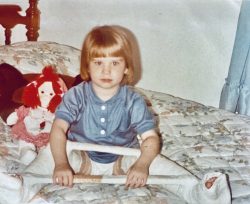
This was taken in May 1984, before they performed my first major hip surgery.
Here We Go Again
I continued growing and doing well until a growth spurt caused my left leg to really take off. My left leg was growing so much and so quickly that it was pushing high up into my hip socket. So, I needed another major surgery to correct it. I was seven when a team of doctors operated and cut a wedge of bone from my femur. I was in a full-length body cast for the second time. After several months of wearing this cast, I relearned to walk again.
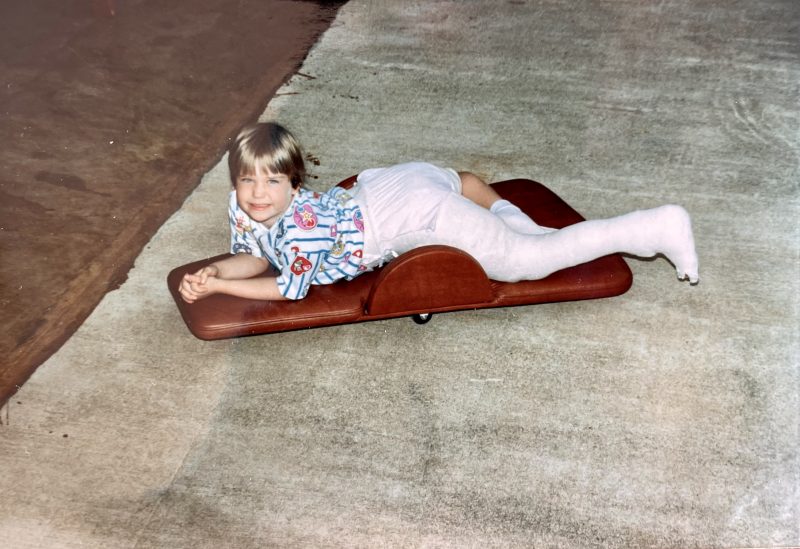
By this time in my life, I had already learned the meaning of “grit”. Before I turned eight years old, I had worn two different full-length body casts. Both casts covered my chest/back up to my armpits. My left leg was casted completely down to the very tips of my toes. My right leg was casted down to my knee. (I’m sharing a couple of childhood photos for reference.)
After the second major surgery, my left leg continued to grow quicker than my right. At one point, the option of another major surgery came up because my left leg continued to outgrow my right. The doctor also said I could wear a heel lift inside my right shoe instead to even out my legs. My parents and I made the choice together and opted for the heel lift and I still wear one.
“Normal-ish” was in my Future
I went on to be a fairly “normal” (whatever that is) kid. There were some particular activities in elementary school that I wasn’t able to do like running the mile on turf. Certain sports, like gymnastics and karate were off-limits, because of the potential of pushing my hip out of socket. I was able to participate in high school sports. I even accomplished some things the doctors said I would never be able to do like sitting “Indian” style. Starting from a very young age, I learned to push through pain and keep going.
My Hip Replacement Story: The Adult Years
Let’s fast forward a bit…
I was used to experiencing hip pain when I over-exerted my leg. That was normal for me from childhood on. When I was somewhere around thirty-one to thirty-two years old, I started to experience a new pain. The new pain was different and it was more in my left thigh, not so much in the hip area. Several tests ruled out avascular necrosis and a few other possibilities. By the time my rheumatologist ordered an MRI, my joint was bone on bone. The rheumatologist couldn’t do anything for me other than refer me to the orthopedic doctor I chose.
The first orthopedic doctor I went to wanted to do an injection under fluoroscopy. It was extremely painful and offered no help at all. He wanted me to go see a more specialized orthopedic doctor at Duke University for a second opinion. He was hopeful that I would be a candidate to have my hip joint resurfaced.
Second Opinion Verdict
I saw the orthopedic doctor at Duke University. His verdict: I needed a total hip replacement “yesterday” and there was nothing left to re-surface. The doctor at Duke even said the original orthopedic doctor I saw could do my replacement. They had attended medical school together. I went back to see the original orthopedic doctor but he refused to do my surgery. He said he would need to use tools he had never used in surgery before because of the complexities of my case.
When he told me he couldn’t do my surgery, I broke down. I was teaching in a severe/profound special education classroom at the time. I had already lost a lot of range of motion in my leg. So much so that I could no longer put my left sock or shoe on my foot. Earlier that week, a student had kicked out at me when he melted down and I had barely escaped. I could no longer get down on the floor to support that student and others like him when they needed me the most. I described the different types of behaviors exhibited daily by my students to the first orthopedic doctor and he shared my concern. A hit or a kick in the right spot could break my hip, perhaps leaving irreparable damage. My joint was already that bad.
Remember that surgery I had when I was seven when the doctors at The Shriner’s Hospital removed a wedge of my femur bone? Well, my femur had healed with a cute little curve in it. Who knew a curve could make matters so messy? I was going to find out it was another reason my replacement story would be complicated!
Time for a Third Opinion
The original surgeon referred me to another one of his friends from medical school, a different specialized orthopedic doctor at Wake Forest in North Carolina. When the day of my appointment finally arrived, he didn’t sugarcoat anything! At first, he said he didn’t know that he could replace my hip at all because of the curve. He didn’t think he had an implant that would fit. He measured again and when he came back in, he told me in no uncertain terms that he could give me zero guarantees that the surgery would be successful or that I would walk out of the hospital. It was concerning and reiterated to me how complicated my hip really was. I agreed to move forward with the surgery because I had no other options.
Three months later, my surgery date arrived. The surgeon removed all the scar tissue from my childhood surgeries and performed the hip replacement. He basically rolled two surgeries into one. Those first few days after the surgery were awful. My pain wasn’t controlled at all. From the moment the spinal block wore off, I was in awful shape. I will refrain from giving further details about my hospital stay experience.
My Hip Replacement Story: Complications
I dealt with some complications from the surgery. I tend to stay a little on the anemic side and have a blood disorder which causes my hemoglobin and hematocrit to run a little low. I lost a lot of blood. Within a couple of days, I was feeling short of breath and very dizzy. Blood tests revealed my hemoglobin had dropped significantly, to transfusion level. I initially thought I might receive a blood transfusion; however, my surgeon wouldn’t agree to it because of the risk of it causing my body to reject the hip implant.
The surgeon informed us that needing to go in and put another hip implant in was completely out of the question at this point because there wasn’t enough bone to do so. We couldn’t risk the chance so I did not receive a blood transfusion. I got to go home after four days in the hospital. I had home health services in place for both nursing care and in-home physical therapy. Home Health continued for around three months, it’s hard to remember exactly because I’ve been through so much the last few years. Details tend to get blurry. After receiving in-home physical therapy, I continued on to outpatient physical therapy.
Say “So long” to the Cane!
My hemoglobin levels had returned to baseline by the time I was released to outpatient physical therapy. I was doing much better than previously however, with continued pain. Only now the pain was different than before. I was no stranger to physical therapy as I had been through it twice before as a child so I gave it my all. I even got to say “so long” to my cane! (Unfortunately, later it came back to stay.)
Job Adjustments
My surgeon was extremely concerned about my job as a special education teacher for students with severe/profound special needs because of the complexities of my hip replacement including the bony deformity in my femur. I was at an increased risk of being injured because of my role. During that time, many of my students had regular bouts of physical aggression. Revision hip surgery was and still is a topic of great concern.
Neither my surgeon nor I wanted to take any unnecessary risks especially knowing I would likely end up no longer able to walk if I broke my new bionic hip. With a letter from my surgeon in hand, the school where I worked was gracious enough to accommodate my needs. I returned to full-time teaching as a resource special education teacher in the fall of 2014-2015.
Obviously, my health story didn’t end here. Lots more happened. You’ll read all about it throughout the posts as I share bits and pieces. I hope sharing this overview of my hip replacement story has been helpful in communicating an important piece of my story!
Leave a Reply